

Retirement housing is becoming an increasing requirement for the UK population as our ageing population changes their lifestyles; reducing or giving up work, focusing on leisure time and moving into homes that better suit or support their needs.
This was of course an inevitability, but the coronavirus pandemic has caused many people to take stock and shift their perspective on how they can make the most of their time.
This article looks at the market for retirement housing, including generational data, changes in the retirement market as well as the impact of the COVID-19 pandemic.
Ageing population
Data from the ONS shows waves in the age structure of the UK population, with a noticeable spike in people aged 73, reflecting the boom in births after the Second World War. There is another large group of people
aged around 49-57, as a result of the baby boom of the 1960s, who have already begun crossing the 55+ age threshold that many retirement communities require.
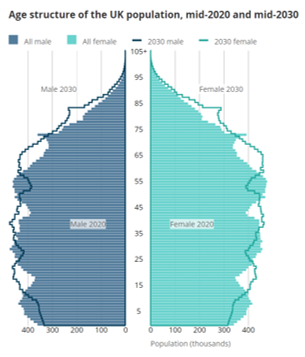
ONS estimates that by mid-2030, there will be an increase in people of retirement age from 11.9% of the 2020 population to 13.2% and, by 2045, this will increase to 15.2%.
Based on current figures and trends, the ONS also estimates that by mid-2045, only slightly more than 20 years away, there will be over 3.1 million people in the UK aged 85 or over – 2.5% of the anticipated UK population. This is partly due to the baby boomers of the 1960s and the extended life expectancy that new medicines and technology bring.
The OADR (old-age-dependency ratio), used to measure how many people of pensionable age there are for every 1,000 people of working age, is expected to grow from 280 in 2020 to 298 in 2030 and 341 in 2045.
Retirement homes
Given the impending growth in people of retirement age, there will undoubtedly be continued growth in the demand for retirement homes, whether that is sheltered accommodation, residential care, assisted living or park homes.
Investec’s Future Living II study found an increase in the number of institutions that are investing in the retirement living sector, going from 20% in 2019 to 33% in 2021. Over half of these institutions have declared that the future of the sector is an appealing investment perspective for the next five years.
This same report highlights the lack of state-built retirement homes that were first established in the final 20 years of the last century, leaving a hole in the market for developers and investors when it comes to housing the UK’s ageing population.
Impact of COVID-19 on retirement plans
As part of the Retirement Living Standards Review, the Centre for Research in Social Policy at Loughborough University conducted a study into the impact of COVID-19 on thinking about and planning for retirement.
Qualitative interviews with a range of people from across the UK and across the age spectrum were conducted and many insights were pulled out, including: “Covid has reinforced the notion that life is finite and you want to make the most of it, rather than cutting around the edges to save a few pounds”.
This feeling of “wanting to have a more quality experience” was echoed by several other participants and those who may be in more comfortable positions are looking at ways to enjoy their remaining years, due to the change in perspective the pandemic brought:
“I’m making arrangements to reduce the amount of work that I’m doing, and our outlook on life has changed a bit – it’s more about getting on with life while you can, you never know what’s around the corner”.
Some have concerns over how far pensions will stretch, with some expecting they will need to continue working ona part-time basis after retirement, to maintain their standard of living.
“I think a lot more work is going to be done from home, so … I think for me, I can see more of a semi-retirement phase. With working from home, I can see more of an overlap between work and retirement, so I think that has changed my thoughts about retirement. There could be an overlap rather than going from full-on work to full-on retirement.”
The virus and the subsequent pandemics have caused some people to evaluate their financial situation and make changes now for the future.
“I went to a financial adviser as soon as Covid started; he started looking at my pension arrangements. Definitely, for me, I utilised that time to reflect on what my future would look like.”
The growing population coupled with the economic fallout of the coronavirus pandemic means there will be large numbers of people who are looking to maximise what money they have during their retirement years, and many of them are thinking now about what their retirement will look like.
How HBB Solutions can help
HBB Solutions specialises in property part-exchange in the retirement market. Making us your PX partner means not only will your customer have support throughout the entire process, but you will too.
Our specialists take care of the entire customer management process, including direct liaison with customers to perfect their PX packages, leaving you to focus on developing the business and making new sales.
Get in touch today to find out more about PX for retirement living.